
AI SEO Does Not Replace Traditional SEO — It Builds On It
The goal is to make your website easy for search engines and AI answer tools to crawl, understand, trust, cite, and recommend when people ask questions relevant to your business.

What Is AI SEO — and How Does It Work?
AI SEO is the practice of improving a website's visibility in AI-powered search experiences, such as Google's AI Overviews and AI Mode, ChatGPT search, Perplexity, Microsoft Copilot, and similar answer engines. You may also hear it called Generative Engine Optimization (GEO), Answer Engine Optimization (AEO), or AI search optimization.
Traditional search typically presents a page of links. AI search often synthesizes an answer, then may cite or recommend a small set of sources. AI SEO aims to increase the likelihood that your business is one of those sources — or is accurately represented in the response.
It works by improving four areas:
Useful, original content:
Publish information that answers real questions with specificity, proof, experience, and details unavailable on generic competitor pages.Clear structure:
Use descriptive headings, concise answer-first sections, comparison tables, step-by-step instructions, and logical internal links so systems can retrieve relevant passages.Trust signals:
Make authors, credentials, sources, dates, company information, policies, and editorial standards visible. Earn reputable third-party mentions, reviews, and coverage.Technical accessibility:
Ensure important content is crawlable, indexable, fast, mobile-friendly, and available as readable page text — not hidden in scripts, images, or gated interfaces.
Google's own documentation is explicit that valuable, unique content and established SEO fundamentals remain the foundation for appearing in its generative search features: "There are no additional requirements to appear in AI Overviews or AI Mode, nor other special optimizations necessary."
There is also early academic evidence that specific content traits matter. The Princeton-led research team that coined the term "Generative Engine Optimization" found that adding citations, quotations from relevant sources, and statistics to content boosted visibility in generative engine responses by up to 40% in their benchmark.
A 2025 Carnegie Mellon study found that cooperative, semantically explicit content earned 35–60% higher citation rates than terse or adversarial equivalents — in plain terms, AI engines cite content that makes their job easier.
What the Data Actually Says
Before tactics, it is worth grounding the stakes in measured data rather than vendor hype. Here is what independent and first-party research shows as of mid-2026.
Fewer clicks on simple questions — but not zero value
Pew Research Center tracked the real browsing behavior of 900 U.S. adults across 68,879 Google searches in March 2025. When an AI summary appeared, users clicked a traditional result link in only 8% of visits, versus 15% when no summary appeared — and clicked a link inside the AI summary itself in just 1% of visits. Sessions were also more likely to end entirely after an AI summary (26% vs. 16%).
Ahrefs analyzed 300,000 keywords and found the top-ranking page lost an average of 34.5% of its clicks when an AI Overview appeared (April 2025). Their follow-up study using December 2025 data found the effect had grown to a 58% lower average click-through rate for position-one content.
Seer Interactive, tracking 42 client organizations, found organic click-through rates on AI-Overview queries fell 61% between June 2024 and September 2025, with paid CTR on the same queries falling 68%.
Google disputes some of these findings — it publicly challenged Pew's methodology and reports that clicks from AI Overviews are "higher quality," meaning users spend more time on the sites they do visit. Both things can be true at once: fewer clicks overall, and better-qualified visitors among those who remain.
AI referral traffic is small but growing fast — and converting better
Semrush's analysis of over 1 billion lines of U.S. clickstream data (October 2024–February 2026) found outbound referral traffic from ChatGPT to the rest of the web grew 206% year over year, reaching roughly 170,000 unique domains per month by early 2026.
Adobe Digital Insights data reported by eMarketer found AI-driven traffic to U.S. retail sites grew 393% year over year in Q1 2026, and — in a reversal from the prior year — AI-referred visitors converted 42% better than non-AI traffic in March 2026, viewed 13% more pages, and generated 37% higher revenue per visit.
The referral landscape is fragmenting. Panel data from Goodie shows ChatGPT's share of measurable B2B AI referrals fell from 89% to 63% in eight months as Claude (18.5%), Gemini (10.6%), and Perplexity (7.3%) grew — so a single-engine optimization strategy is increasingly fragile.
What people ask AI matters more than how many
Pew's data shows AI summaries are not evenly distributed: they appeared on 18% of all searches in March 2025, but on 60% of searches that began with a question word and 53% of searches with 10 or more words — exactly the research-heavy, multi-part questions that precede considered purchases.
Gartner's February 2024 prediction that traditional search volume would drop 25% by 2026 has not fully materialized — Google still holds over 90% of the search market — but the shape of search has changed: Google absorbed the shift by putting AI answers inside its own results page rather than losing users to chatbots.
The Takeaway:
Organic rankings still matter, clicks are scarcer on informational queries, and the clicks that survive AI summarization skew higher-intent. That is precisely the customer journey AI SEO is designed for.
Traditional SEO vs. AI SEO
Traditional SEO and AI SEO overlap substantially, but they measure success differently.
| Area | Traditional SEO | AI SEO |
|---|---|---|
| Primary Goal | Rank webpages prominently in organic results | Be retrieved, cited, summarized, or recommended in AI-generated answers |
| Typical User Journey | Search → click a result → browse the website | Ask a question → receive a synthesized answer → possibly click cited sources |
| Main Optimization Focus | Keywords, intent, technical health, links, content quality, local visibility | Clear answers, source-worthy facts, entity credibility, structured content, brand mentions, and SEO fundamentals |
| Success Metrics | Rankings, impressions, clicks, organic sessions, leads, revenue | AI citations, brand mentions, accuracy of brand representation, AI-referral traffic, assisted conversions, and revenue |
| Content Format | Landing pages, blog posts, category pages, local pages | Those same pages, plus well-structured FAQs, comparisons, guides, research, demonstrations, and authoritative reference content |
| Risk of Shortcuts | content may be ignored, misrepresented, or fa | Generic AI-generated content may be ignored, misrepresented, or fail to earn citations |
The key point: there is no reliable "AI SEO trick" that overrides conventional SEO. Google's AI experiences use the same index, the same crawl, and the same ranking systems as regular Search, and Google states plainly that "you don't need to create new machine readable files, AI text files, or markup to appear in these features.
There's also no special schema.org structured data that you need to add." Strong organic visibility improves the foundation for AI visibility, but it does not guarantee a citation.
One genuinely new mechanic is worth understanding: query fan-out.
When you ask a complex question, Google's AI breaks it into multiple related sub-queries issued simultaneously behind the scenes — Google's own example turns "how to fix a lawn that is full of weeds" into background searches like "best herbicides for lawns" and "remove weeds without chemicals."
A page that thoroughly answers one of those sub-questions can be cited even if it never ranked for the original query. The practical lesson: cover a topic's natural sub-questions comprehensively on one strong page.
Do not spin up a separate thin page per sub-question — Google explicitly warns that generating pages primarily to target fan-out variations falls under its scaled content abuse spam policy.
Does AI SEO Affect Rankings?
AI SEO can improve the inputs that support search performance — better content, clearer information architecture, legitimate structured data, faster pages, stronger authority, and more useful answers. Those improvements may also help traditional rankings.
However, AI SEO does not create a separate guaranteed ranking position. A page can rank well without being cited in a specific AI response, and a cited source may change as queries, freshness needs, sources, and AI systems evolve.
Google shows an AI Overview only when its systems decide a summary adds value beyond classic results, so the same page can be quoted one week and absent the next. Treat AI visibility as an additional discovery channel, not a replacement for organic rankings.
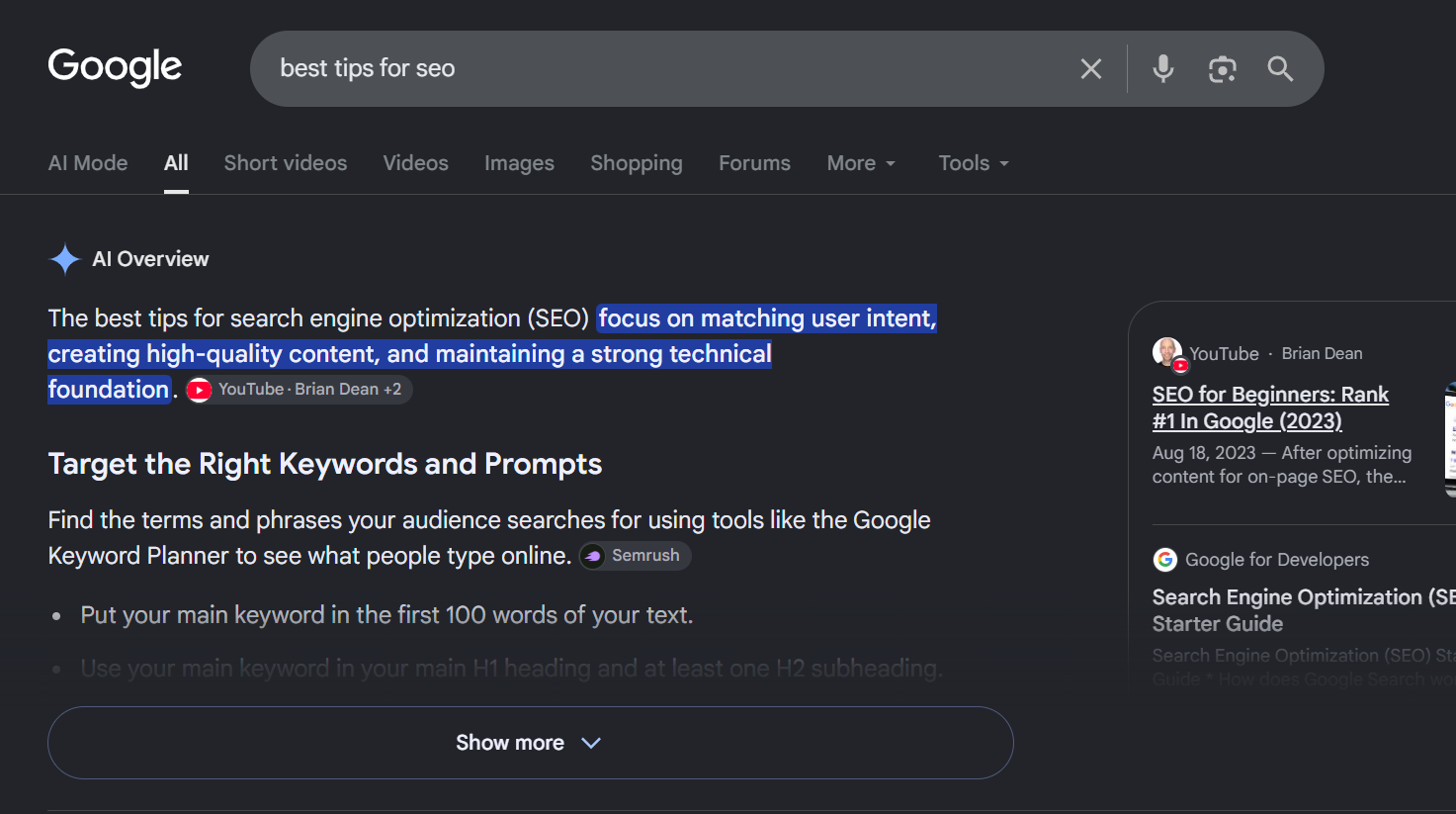
Example of a Google AI Overview.
Note also that enforcement has caught up with the hype: since May 2026, Google's spam policies explicitly name "attempting to manipulate generative AI responses" as a violation, alongside its long-standing scaled content abuse policy (introduced in the March 2024 spam update), which targets mass-produced low-value pages regardless of whether they were written by AI or humans.
Paid citation schemes and manufactured brand mentions now carry the same category of risk as bought links.
How AI SEO Affects Your Business
For website owners, the change is less about "AI taking over SEO" and more about adapting to a different customer journey.
A potential customer may now receive a short answer before deciding whether to visit your site. That can reduce clicks for simple informational questions, while making clicks that do occur more valuable — especially when users need proof, pricing, a demonstration, a quote, an appointment, or a purchase.
The conversion data supports this: AI-referred retail visitors, which converted worse than average in early 2025, were converting 42% better than non-AI traffic by March 2026.
Your business can benefit when AI systems:
Cite your guides, research, product pages, or local-business information.
Describe your company, products, services, and differentiators accurately.
Recommend you for the right use case or customer need.
Send higher-intent visitors who want deeper evidence or are ready to act.
Reinforce brand awareness before a user searches for your company by name.
The downside is that vague, duplicated, outdated, or untrustworthy content is easier to bypass. If your site only rephrases information already available everywhere else, an AI tool has little reason to cite it instead of a better primary source.
A worked example of the new funnel:
1. A facilities manager asks ChatGPT, "What's the payback period for commercial solar on a 50,000 sq ft warehouse in Texas?"
2. The AI synthesizes an answer citing three sources — an industry report, a government incentives page, and one installer whose site published state-specific payback data by building type.
3. The manager never sees ten blue links. She visits one site: the installer's.
That visit is worth more than fifty casual blog readers, and it happened because the installer published information nobody else had in that form.
Industries Most Affected
The biggest impact tends to fall on industries where customers ask research-heavy, comparison-based, local, or multi-step questions — the same long, question-style queries that trigger AI summaries most often.
| Industry | Why AI SEO matters | Sample questions customers now ask AI |
|---|---|---|
| E-commerce and retail | Shoppers ask for product comparisons, gift ideas, buying guidance, specifications, alternatives, and recommendations. Accurate product data, reviews, policies, and comparison content are critical. | "What's the best cordless vacuum for pet hair under $300?" · "Is Brand X's warranty actually better than Brand Y's?" |
| Local services | People ask questions such as "best emergency plumber near me," "roof repair cost," or "family dentist accepting new patients." Consistent location, service, review, and availability information matters. | "How much does a roof repair cost in Denver in 2026?" · "Which dentists near me take Delta Dental and have Saturday hours?" |
| Travel and hospitality | Travelers research destinations, itineraries, hotels, activities, transit, accessibility, and local recommendations — often through multi-step planning questions. | "Plan a 4-day Lisbon itinerary for a family with a stroller and a €150/day budget." |
| B2B software and professional services | Buyers compare vendors, features, pricing models, integrations, implementation requirements, and use cases before speaking with sales. G2's Answer Economy 2026 report found 51% of B2B software buyers now begin research in an AI chatbot more often than Google — up from 29% in April 2025 — and 69% said they chose a different vendor than initially planned based on AI chatbot guidance. | "Compare HubSpot vs. Salesforce for a 20-person services firm" · "Which AP automation tools integrate with NetSuite?" |
| Healthcare, legal, and financial services | Users ask high-stakes questions that demand clear, carefully reviewed, accurate content. These businesses need strong expertise signals, appropriate disclaimers, and compliance review. | "What's the difference between a Roth and traditional IRA for a freelancer?" · "Do I have a case if I was injured in a store?" |
| Education and training | Prospective students compare programs, requirements, career paths, costs, schedules, and outcomes. Detailed, structured first-party information can be highly useful. | "Is a data analytics bootcamp worth it vs. a master's?" · "HVAC certification requirements in Ohio?" |
These sectors are not "most affected" because AI SEO is a magic ranking system. They are affected because buyers naturally ask the kinds of complex, comparative, and follow-up questions that AI search is designed to handle.
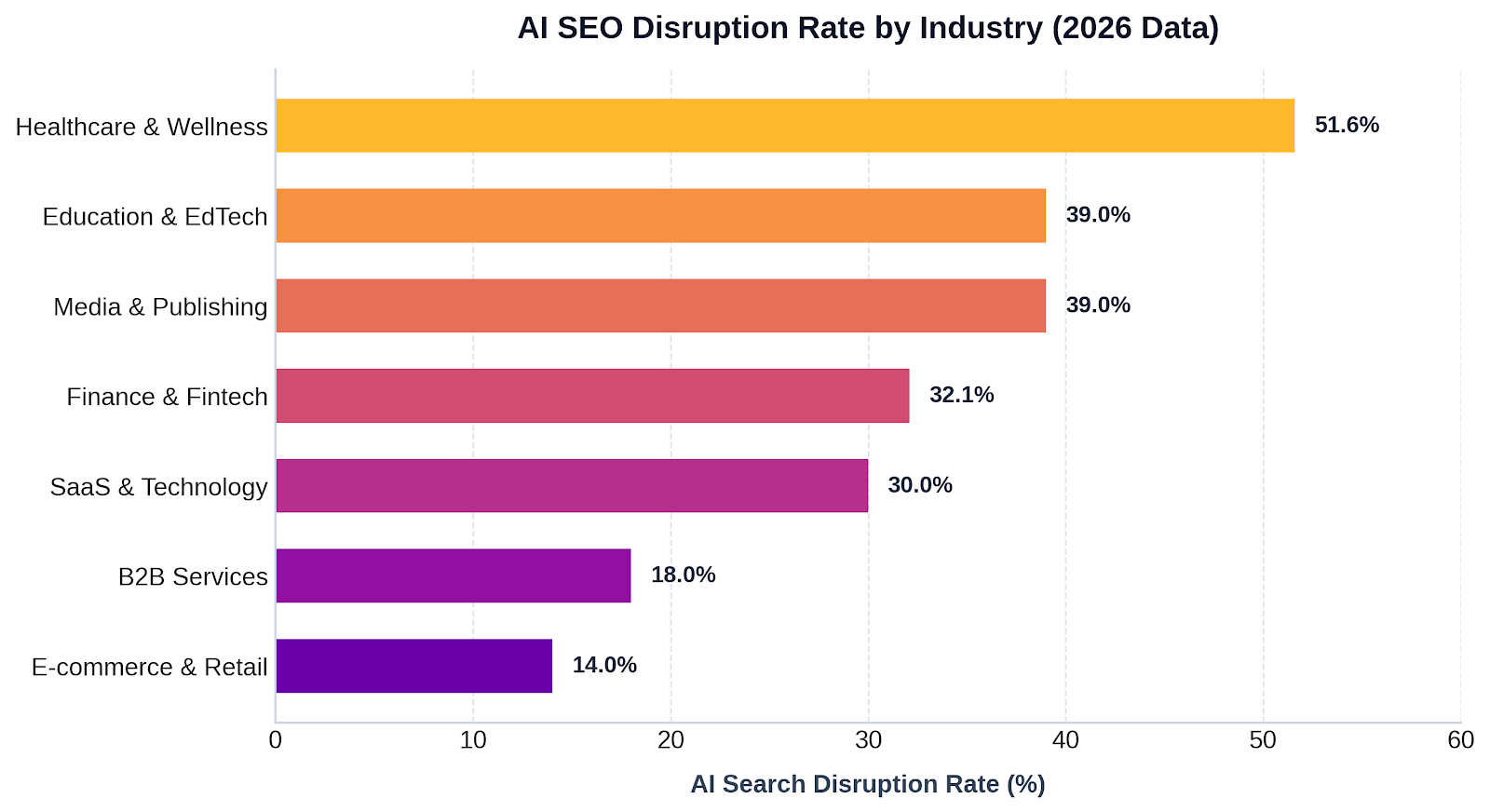
How to Optimize for Both
The best implementation is not a separate AI-only website. It is a disciplined content, technical SEO, and authority program that serves people first and makes the same information easy for systems to verify and retrieve.
Microsoft's Bing team describes the underlying mechanic well: AI assistants "break content into smaller, usable pieces — a process called parsing" — so the unit of competition is no longer the page, it's the passage.
1. Start with an SEO and AI-visibility audit
Review your highest-value pages first: service pages, category pages, product pages, comparison pages, local landing pages, and lead-generating guides.
Check whether each page:
Is crawlable, indexable, mobile-friendly, and fast.
Has a clear purpose and answers a specific customer need.
Shows an accurate author, business identity, contact information, and update date where appropriate.
Contains original facts, examples, customer proof, policies, or real expertise.
Includes a focused next step, such as booking, requesting a quote, downloading a guide, or making a purchase.
Then add an AI-visibility baseline — this is the part most audits skip.
Assemble 20–30 real customer questions (from sales calls, support tickets, and Search Console) and run them monthly through ChatGPT, Perplexity, Gemini, Copilot, and Google AI Overviews.
Record for each: Were you cited? Were competitors? Was the description of your business accurate?
A simple spreadsheet works:
| Question | Engine | Cited? | Accurate? | Competitor cited | Notes |
|---|---|---|---|---|---|
| "emergency AC repair cost [city]" | AI Overviews | No | - | Competitor A | They have a pricing page; we don't |
| "[your brand] reviews" | ChatGPT | Yes | Partly wrong | - | Cites an outdated address from an old directory listing |
That second row is a real and common failure mode: the AI isn't ignoring you — it's repeating stale information from a source you control or can correct. Fix the upstream source (directory listings, old press pages, your own outdated pages), not just your website.
2. Build content around customer questions
Use sales calls, support tickets, on-site search data, Search Console queries, reviews, and competitor gaps to find questions your customers repeatedly ask.
For each priority topic:
Give the direct answer near the top.
Use question-based headings that match natural customer language.
Add detail, caveats, steps, examples, and supporting evidence below the answer.
Include comparison tables where customers are evaluating options.
Link to relevant supporting pages and conversion pages.
Example #1: B2B/Industrial
Rather than publishing "A Complete Guide to Commercial Solar," create useful decision content such as "Commercial Solar Cost in 2026," "Lease vs. Purchase: Which Is Better for a Warehouse?," "Solar Payback by Building Type," and "Questions to Ask Before Choosing an Installer."
Example #2: Local Services
A family dentistry practice replaces one generic "Our Services" page with a cluster that answers real questions: "How Much Does a Dental Crown Cost in [City]?," "Do You Accept [Top 5 Local Insurance Plans]?," "What to Do If Your Child Chips a Tooth," and "Same-Day Emergency Appointments: How They Work." Each page leads with a direct, quotable answer.
Example #3: E-commerce:
A coffee equipment retailer builds "Espresso Machine vs. Super-Automatic: Total 5-Year Cost Compared," "The 3 Grinders Our Repair Team Would Buy Themselves," and a maintenance-cost-per-shot calculator — content with numbers a competitor's generic category page doesn't have.
Answer-first, in practice. This is what the rewrite actually looks like:
Before: "When considering the various factors that go into water heater replacement, many homeowners find themselves wondering about the overall investment involved…" (120 words later, a price appears.)
After: "**A standard 50-gallon tank water heater replacement in Austin typically costs $1,400–$2,200 installed in 2026, including permit and haul-away. Tankless units run $3,000–$4,800.** Here's what moves the price up or down…"
The second version gives an AI engine a self-contained, citable passage in the first two sentences — Microsoft's guidance calls this making answers "snippable" — while the human reader still gets the detail below.
3. Become a source worth citing
AI systems and search engines have little incentive to surface a page that merely repeats generic advice. Create information that demonstrates real-world experience:
Original research, surveys, benchmarks, calculators, templates, or data.
Case studies with clear context and realistic results.
Product demonstrations, walkthrough videos, installation guides, or before-and-after examples.
Expert commentary with named authors and verifiable qualifications.
Accurate local, product, pricing, availability, and policy information.
The GEO research gives this a concrete edge: content enriched with statistics, quotations, and explicit citations measurably outperformed unenriched content on generative-engine visibility.
In practice, that means upgrading a claim like "demand for heat pumps is growing" into "U.S. heat pump shipments exceeded gas furnace shipments for the third consecutive year in 2025, according to AHRI shipment data" — with a link to the primary source. One version is filler; the other is citable.
Make factual claims easy to verify by linking to primary or authoritative sources. Clear sourcing, author bios, research methods, and update dates help users judge credibility and make your content easier to evaluate.
Where possible, be the primary source: a multi-location HVAC company that publishes "average repair vs. replace cost from 1,200 jobs we completed in 2025" owns data no competitor can copy.
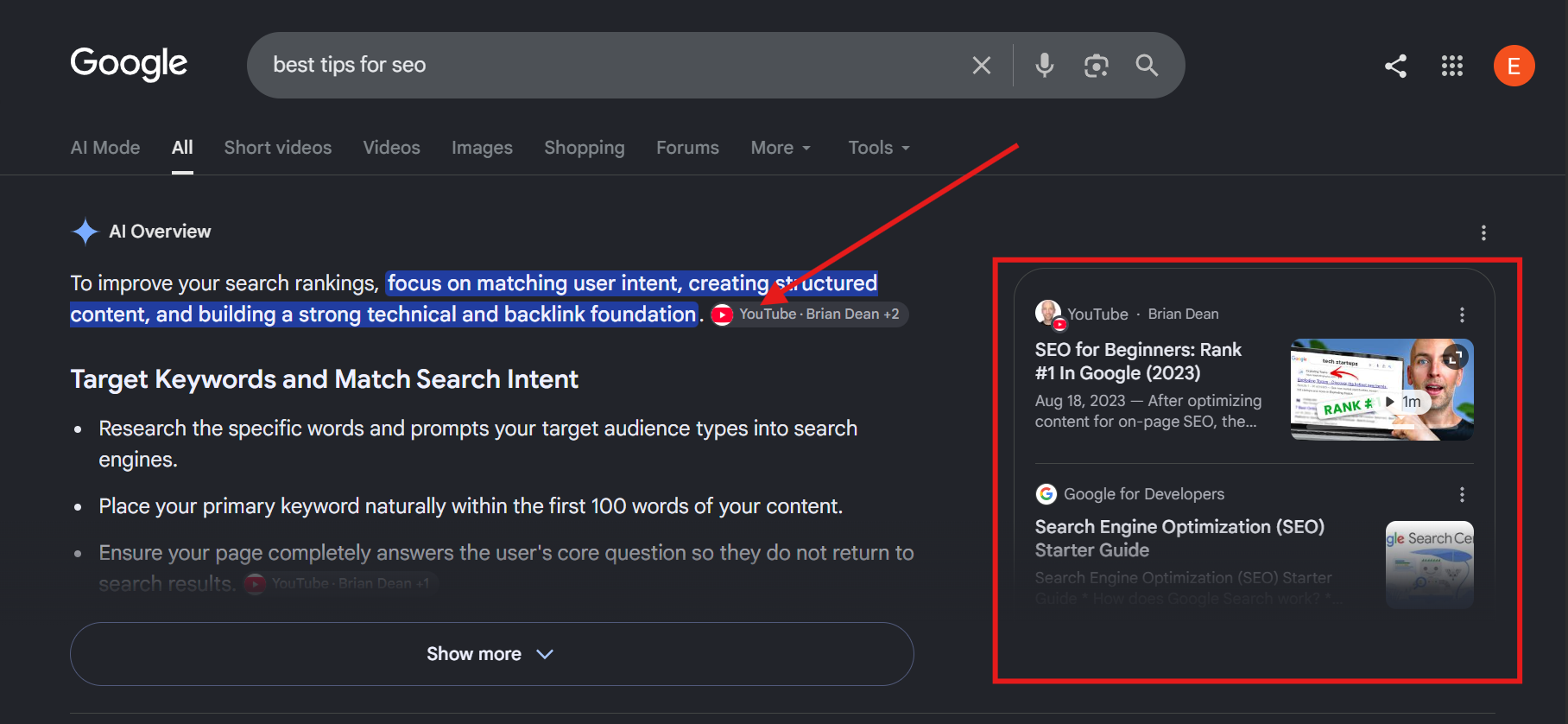
Example of a Google AI Overview citing sources.
4. Strengthen technical foundations
Prioritize the technical work that benefits both traditional and AI search:
Maintain a logical site hierarchy and internal-linking structure.
Use descriptive title tags, headings, image alt text, and readable URLs.
Ensure core page information renders as text (server-rendered or reliably renderable).
Improve performance and mobile usability.
Add valid structured data where it genuinely describes the page — such as Organization, LocalBusiness, Product, Review, Article, or BreadcrumbList — and make sure it matches the visible content exactly.
Google is explicit that no schema type grants entry to AI features; schema's job is helping systems understand content and powering classic rich results.Use canonical tags and avoid duplicate or contradictory versions of important content.
Review crawler access intentionally; do not block AI or search bots by accident.
This is now a real audit item, not a hypothetical. OpenAI, for example, uses separate crawlers with separate controls: `OAI-SearchBot` surfaces your site in ChatGPT search answers, `GPTBot` collects training data, and `ChatGPT-User` fetches pages when a user asks about your site.
OpenAI notes that opting out of OAI-SearchBot means your site "will not be shown in ChatGPT search answers." If your robots.txt or CDN/WAF rules blanket-block AI user agents, you may have opted out of an entire discovery channel without realizing it:
# robots.txt — example: visible in ChatGPT search, opted out of training

User-agent: OAI-SearchBot

Allow: /

User-agent: GPTBot

Disallow: /

User-agent: PerplexityBot

Allow: /
Two myths to retire, per Google's own documentation:
you do not need an `llms.txt` file, and
there is no special AI markup — Google may crawl such files like any other file but assigns them no special meaning for AI features.
For retailers and local businesses, keep your Google Merchant Center feed and Business Profile accurate — generative responses can pull product and local-business information directly from them.
Structured data helps systems understand the meaning of your content, but it is not a shortcut or a guarantee of AI inclusion.
5. Measure business outcomes, not hype
Track both channels separately:
Traditional rankings, impressions, clicks, organic conversions, and revenue. (Note: Google counts AI Overviews as a single position block in Search Console, blended into Web search — there is no separate filter, so pair GSC with query-level tracking.)
Referrals from AI platforms where attribution is available. In GA4, create a custom channel group or segment with a source/medium regex such as `chatgpt | perplexity| gemini | copilot | claude | grok | deepseek` to isolate AI referrers — then judge that traffic on conversion rate and revenue per session, not just volume.
Panel data suggests GA4's referrer view understates AI influence (native apps and AI Mode don't pass referrers), so report it as a floor, not a ceiling.Whether your brand or URLs appear in AI answers for your priority questions (the baseline audit from step 1, re-run monthly).
Citation accuracy: is the AI describing your company correctly? Check names, addresses, pricing, and claims against current reality.
Assisted conversions, branded searches, lead quality, and revenue per visitor.
AI visibility can be volatile, so review performance regularly and refresh important content when facts, pricing, regulations, products, or user needs change.
Cost and Best Implementation Path
There is no fee paid to Google or an AI tool to "add AI SEO" to a website. The cost comes from the work: auditing, technical fixes, content improvement, original research, digital PR, monitoring, and ongoing updates.
Typical Budget Ranges
Pricing varies heavily by market, website size, industry competition, content volume, and whether you use in-house staff, freelancers, software, or an agency.
| Approach | Typical Scope | Indicative Cost |
|---|---|---|
| DIY / in-house | Audit, basic technical cleanup, content refreshes, existing analytics | Primarily internal time; self-serve AI-visibility monitoring tools run roughly $29–$489/month |
| Focused audit | Technical review, content opportunity map, citation baseline, priority-page recommendations, measurement setup | Roughly $1,500–$5,000 for a standalone audit |
| Small-business monthly program | Local or niche SEO, a limited number of content upgrades, reporting, basic authority work | Often roughly $1,500–$3,000+ per month |
| Mid-market SEO + AI visibility program | Content production, technical work, digital PR, multi-platform monitoring, conversion measurement | Commonly about $2,000–$10,000 per month; most credible retainers cluster in this band |
| Enterprise program | Multiple sites, markets, languages, large content operations, data assets, PR, governance, and advanced reporting | Typically $10,000–$30,000+ per month; some enterprise GEO programs exceed $25,000 |
These are broad market benchmarks, not fixed rates.
For calibration: Ahrefs' survey of 439 SEO agencies found the most common traditional SEO retainer is just $500–$1,000/month, and agency-published pricing research consistently places mid-market GEO/AEO retainers at a premium to that — in the $2,000–$10,000 range — with full-service enterprise programs in the five figures.
Building the capability in-house is the other end of the spectrum: roughly $80,000–$180,000 per year in fully loaded salary plus tooling for a dedicated specialist.
Two pricing red flags worth knowing.
Red Flag #1: Sub-$1,500/month "complete AEO" offers are almost always rebranded basic SEO.
Red Flag #2: Beware paying for dashboards instead of work: a monitoring tool shows where you stand, but content and authority work is what moves the number. If a vendor can't name which engines they track (ChatGPT, Perplexity, AI Overviews, Copilot…) and what they'll change on and off your site, keep looking.
The Best Way to Implement AI SEO
For most website owners, use a staged approach:
Fix fundamentals first: Resolve indexation, site speed, mobile, architecture, duplicate-content, and conversion issues.
Choose 10–20 high-value pages: Start with pages tied directly to leads, sales, local visibility, or important customer questions.
Upgrade those pages deeply: Add direct answers, original evidence, expert input, clear structure, relevant schema, and strong calls to action.
Create source-worthy assets: Publish research, tools, real examples, demonstrations, or detailed comparisons your competitors cannot easily copy.
Build authority beyond your site: Earn legitimate reviews, industry coverage, mentions, partnerships, and citations. Pew's data reinforces why: the most frequently cited sources in AI summaries are the web's most established entities — Wikipedia, YouTube, Reddit, and .gov sites — which means off-site reputation is part of the citation game, not just your own pages.
Measure, learn, and expand: Track organic and AI-originated visibility, then apply what works to the next group of pages.
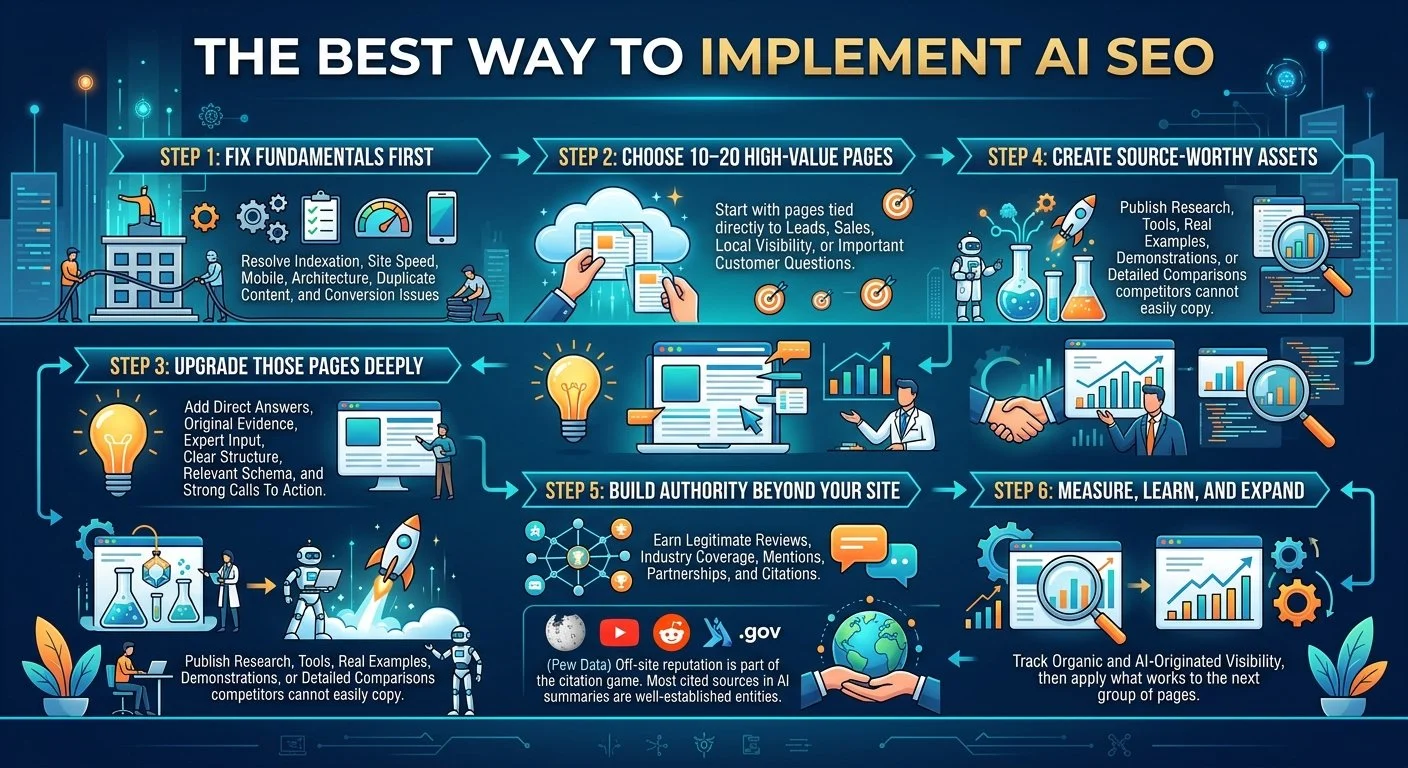
An infographic of the steps mentioned above.
The best AI SEO strategy is therefore not "generate more content with AI." It is to create a website that is more accurate, useful, distinctive, technically accessible, and trustworthy than the alternatives.
That approach protects traditional search performance while improving your chance of earning visibility in AI-driven search experiences.
Appendix: Where to Verify These Claims Yourself
Not all sources are equal. When evaluating any AI SEO claim (including ours), check it against this hierarchy:
1. Platform documentation (the source of truth for how each engine works): Google Search Central's "AI features and your website,"[^1] Google's Search Central Blog guidance for AI experiences,[^2] Google's spam policies,[^5] OpenAI's crawler documentation,[^3] and Microsoft's AI search content guidance.[^4] If a tactic contradicts these, the tactic is wrong.
2. Peer-reviewed / academic research on how generative engines select sources.[^6][^7]
3. Independent measurement studies of real user behavior and traffic (Pew, Ahrefs, Seer, Semrush, Adobe).[^8][^9][^10][^11][^12] Read the methodology notes — these studies measure different things, which is why their numbers differ.
4. Analyst forecasts (Gartner) — useful for direction, wrong on timelines more often than not.[^14]
5. Agency-published benchmarks for pricing and practice — directionally useful, commercially motivated, always cross-checked.[^18][^19][^20]
Sources
[^1]: Google Search Central, "AI features and your website" (May 2025, updated): no additional requirements, query fan-out, snippet controls, no special files or schema — https://developers.google.com/search/docs/appearance/ai-features
[^2]: Google Search Central Blog, "Top ways to ensure your content performs well in Google's AI experiences on Search" (May 2025) — https://developers.google.com/search/blog/2025/05/succeeding-in-ai-search
[^3]: OpenAI, "Overview of OpenAI Crawlers" (OAI-SearchBot, GPTBot, ChatGPT-User; robots.txt controls; ChatGPT search eligibility) — https://platform.openai.com/docs/bots
[^4]: Krishna Madhavan (Microsoft Advertising / Bing team), "Optimizing Your Content for Inclusion in AI Search Answers" (October 2025): parsing, snippable passages, schema, clarity — coverage and quotes via Search Engine Roundtable, https://www.seroundtable.com/microsoft-ads-optimize-for-ai-search-answers-40241.html
[^5]: Google Search Central, "Spam policies for Google web search" — scaled content abuse (March 2024 spam update) and, since May 2026, manipulating generative AI responses — https://developers.google.com/search/docs/essentials/spam-policies (policy-change reporting: Stan Ventures, "8 Things Google Has Said About AI Overviews, On the Record," https://www.stanventures.com/news/8-things-google-has-said-about-ai-overviews-on-the-record-7576/)
[^6]: Aggarwal et al., "GEO: Generative Engine Optimization" (Princeton/IIT Delhi, KDD 2024), arXiv:2311.09735 — https://arxiv.org/abs/2311.09735
[^7]: Chen et al., "What Generative Search Engines Like" (Carnegie Mellon, 2025), arXiv:2510.11438 — summarized in Presenc AI's GEO research digest, https://presenc.ai/guides/essential-geo-research-papers
[^8]: Pew Research Center, "Do people click on links in Google AI summaries?" (July 22, 2025) — https://www.pewresearch.org/short-reads/2025/07/22/google-users-are-less-likely-to-click-on-links-when-an-ai-summary-appears-in-the-results/
[^9]: Ahrefs, "Update: AI Overviews Reduce Clicks by 58%" (February 4, 2026; original 34.5% study April 17, 2025) — https://ahrefs.com/blog/ai-overviews-reduce-clicks-update/
[^10]: Seer Interactive AI Overview CTR study (November 4, 2025), summarized in PPC Land, "Researchers find Google AI Overviews cut publisher clicks 39.8%" — https://ppc.land/researchers-find-google-ai-overviews-cut-publisher-clicks-39-8/
[^11]: Semrush, "ChatGPT traffic analysis: Insights from 17 months of clickstream data" (April 2026) — https://www.semrush.com/blog/chatgpt-search-insights/
[^12]: Adobe Digital Insights via eMarketer, summarized in Cognizo, "ChatGPT AI visibility statistics for 2026" (August 2026) — https://www.cognizo.ai/blog/chatgpt-ai-visibility-statistic
[^13]: Goodie, "AI Search Traffic Report 2026 (Wave 2)" — https://higoodie.com/blog/ai-search-traffic-report-2026/
[^14]: Gartner press release, "Gartner Predicts Search Engine Volume Will Drop 25% by 2026" (February 2024); 2026 reality check: Future Factors, "Gartner Said Search Would Drop 25% in 2026. It Didn't." — https://futurefactors.ai/gartner-search-traffic-drop-prediction-2026-reality/
[^15]: Google AI features documentation commentary on llms.txt and AI markup myths; Layer 3 Labs, "Scaled Content Abuse: Google's Spam Policy Explained" — https://www.layer3labs.io/guides/scaled-content-abuse
[^16]: G2, "Answer Economy 2026" report, cited in Optimist, "The 7 Best GEO Agencies Driving Real Revenue from AI in 2026" — https://www.yesoptimist.com/best-geo-agencies/
[^17]: John Mueller (Google) on Search Console position counting for AI Overviews, via Lumar, "May 2025 SEO News" — https://www.lumar.io/blog/industry-news/seo-news-may-2025-google-io-announcements-ai-mode-search-more/
[^18]: Humans with AI, "What AEO and GEO Actually Cost in 2026" (tool pricing $29–$489/mo; retainer tiers; Ahrefs 439-agency survey) — https://humanswith.ai/blog/what-aeo-and-geo-actually-cost-in-2026
[^19]: Astral3, "How Much Does GEO Cost? Pricing Guide for 2026" (audit, retainer, project, and in-house benchmarks) — https://astral3.io/blog/geo-cost-pricing-guide/
[^20]: The Digital Elevator, "AEO and GEO Pricing Guide: How Much Does AI Search Optimization Cost in 2026?" — https://thedigitalelevator.com/blog/aeo-and-geo-pricing-guide/